Dagenham Dock business removals for local warehouses
Posted on 14/07/2026 by Mark Herrington
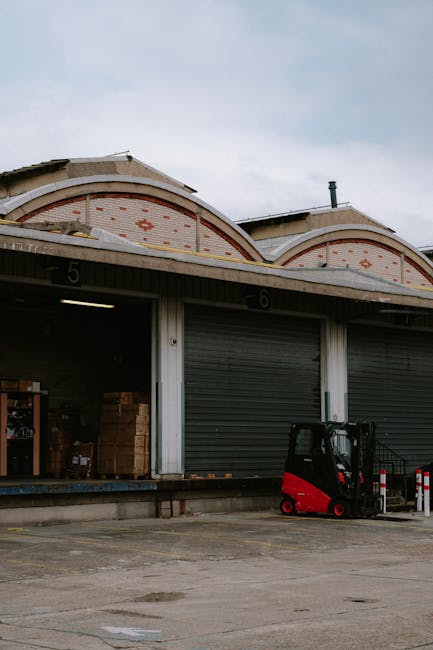
![A yellow forklift truck is positioned outside a large industrial warehouse with blue corrugated metal walls, preparing for furniture transport during a home relocation or commercial move. The forklift is lifting or positioning materials near a wide, green sliding door, which is partially open, showing an interior space suitable for moving larger items like furniture and appliances. The area surrounding the warehouse is paved with concrete, with orange and yellow safety barriers placed on the ground near the forklift to facilitate safe loading operations. The scene is illuminated by natural daylight, with no active personnel in view, indicating either an idle moment in the loading process or a quiet phase of moving logistics managed by a professional removal service such as Man with Van Dagenham. Visible elements include the forklift, some packing materials or parcels on top of the vehicle, and the exterior of the warehouse, emphasizing the professional handling of business or household relocation tasks, aligned with the scope of removals services provided by [COMPANY_NAME].](/pub/blogphoto/dagenham-dock-business-removals-for-local-warehouses1.jpg)
Dagenham Dock Business Removals for Local Warehouses: A Practical Guide for Smooth, Low-Disruption Moves
If you are planning Dagenham Dock business removals for local warehouses, chances are you are not moving a sofa and a few boxes. You are moving stock, equipment, paperwork, pallets, and a workflow that probably cannot afford much downtime. That is a very different job. The risks are different too: missed loading windows, poor access planning, damaged inventory, and staff standing around waiting for the next truck. Not ideal.
This guide breaks down how warehouse removals in Dagenham Dock actually work, what to expect, and how to keep the move organised from the first survey to the final handover. You will also find practical tips, common mistakes, a comparison table, and a simple checklist you can use on the day. If you are comparing wider support options, it may also help to look at the full range of removal services and, where relevant, office removals in Dagenham for mixed-use business moves.
Why Dagenham Dock business removals for local warehouses Matter
Dagenham Dock sits in a part of east London where logistics, storage, and industrial activity matter. That means warehouse moves are not just about shifting physical items; they are about protecting trading continuity. A warehouse that closes for a day may lose picking time, dispatch slots, or incoming stock capacity. A warehouse that closes badly can cause a ripple effect across suppliers and customers. And that ripple gets expensive quickly.
What makes this area different is the practical layout of the work. Local industrial estates often have tight access routes, vehicle timing rules, shared yards, loading restrictions, and neighbours who are running their own operations. So the move has to be planned with real care. Not theory. Real care. In our experience, the best moves are the boring ones: the ones where every cage trolley, label, and pallet position has been thought through before the van arrives.
If you are also weighing property or site changes in the area, it can help to understand the local context first. A broader read like a guide to Dagenham's local character can be useful, especially if your warehouse move is tied to expansion, lease changes, or redevelopment. For some businesses, there is also a strong link between business relocation timing and property transactions in Dagenham.
Expert summary: Warehouse removals work best when logistics, packing, access, and downtime are planned as one system. If one part slips, the whole move tends to feel harder than it should. That is the honest truth.
How Dagenham Dock business removals for local warehouses Works
A warehouse move is usually split into clear phases. It is rarely a single-day event unless the site is very small, and even then, it is worth assuming there will be follow-up checks. The process normally starts with a survey or detailed briefing. From there, the mover maps access, vehicle size, item categories, and timing. Then comes packing, labelling, dismantling if needed, loading, transport, unloading, and placement at the destination.
For local warehouses, the real work is in the sequence. Staff need to know what gets packed first, what stays live until the end, and what must be available on arrival. If you are moving stock and equipment at the same time, the move should be ordered by function. Fast-moving stock, fragile goods, IT kit, and manual handling items all need different treatment. One box of paperwork is never just one box of paperwork. Usually it becomes three boxes and a mild headache if nobody labels it properly.
Many warehouse moves also benefit from a mixed approach. For lighter, more flexible loads, a man and van service in Dagenham may be suitable. For larger or more structured moves, a dedicated removal van and an experienced team are usually the safer choice. If you need help with broader business planning, removal services in Dagenham can cover more than just transport.
Typical stages of a warehouse relocation
- Initial assessment: site access, load size, timings, and special items are reviewed.
- Move plan: the sequence for stock, equipment, and essential documents is agreed.
- Packing and labelling: items are grouped by zone, job, or delivery priority.
- Protected handling: fragile or valuable goods are wrapped, strapped, or crated as needed.
- Loading and transport: the team loads efficiently while keeping traffic flow in mind.
- Delivery and placement: items are unloaded into the correct areas, not just left in a pile.
- Final checks: counts, damage checks, and sign-off happen before the move is closed out.
Key Benefits and Practical Advantages
The biggest benefit of using a specialist approach for warehouse removals is control. Control over time, stock, handling, and the final setup. When you have control, you reduce the chance of expensive mistakes. Simple enough, but easy to underestimate.
Here are the advantages that matter most to local warehouses in Dagenham Dock:
- Less downtime: careful planning helps your team restart faster at the new site.
- Better stock protection: properly labelled goods are easier to track and less likely to go missing.
- Safer handling: the right lifting methods reduce injury risk and reduce damage.
- Cleaner handover: organised unloading means your new warehouse becomes workable sooner.
- More flexibility: the move can be phased around dispatch cycles, shift changes, or delivery slots.
- Lower stress: yes, that counts. A lot.
There is also a commercial benefit that people often forget. A well-run warehouse move protects customer service. If your outbound operations keep moving, even partially, then your business looks steady. That matters to suppliers, clients, and staff who are watching the process unfold. A tidy move says a lot about the company behind it.
For businesses with seasonal peaks or overlapping storage needs, storage in Dagenham can be useful as a buffer. And if the warehouse move includes heavy or fragile specialist items, a service such as furniture removals in Dagenham may offer the handling structure you need for awkward loads.
Who This Is For and When It Makes Sense
This kind of removal is not only for giant distribution centres. It is relevant for a wide mix of local warehouse users, from small wholesalers to e-commerce operators and trade suppliers. If your site stores stock, tools, racking components, packaging, or office support equipment, you are in the right territory.
You may need a warehouse move if you are:
- relocating to a bigger industrial unit
- downsizing after a lease change
- consolidating two storage sites into one
- moving stock after a business acquisition
- reconfiguring your layout for faster picking and dispatch
- dealing with urgent site access problems or a time-limited handover
Sometimes the trigger is not growth but pressure. A damaged roof, a lease expiry, a rent increase, or a changed supply pattern can all push a move forward. In those cases, it is worth thinking beyond the van. You need a move partner who understands business continuity, not just lifting and carrying.
If the warehouse also has an attached admin area, the transition may overlap with office removals. That mixed setup is common, and it deserves a plan of its own. It is also where experienced removal companies in Dagenham can add genuine value, especially if you want one team to coordinate both sides of the move.
Step-by-Step Guidance
If you want the move to feel manageable, do not treat it like a last-minute load-out. Break it down. That is the trick. Here is a sensible working order that suits most local warehouse removals.
1) Start with a site walkthrough
Walk the current warehouse and the destination site if possible. Look at access width, stairs, lifts, hardstand areas, dock access, and turning space. A few minutes spent here can save a lot of drama later. If a van cannot get close enough, every other task gets slower.
2) Separate items by priority
Mark what must move first, what can wait, and what should stay accessible until the end of the day. This is especially useful for stock that is already allocated to orders. Keep urgent goods separate and obvious. No mystery boxes. Nobody needs those.
3) Build a labelling system
Use simple, consistent labels: zone, content type, destination area, and any handling notes. The point is not to make the labels pretty. The point is to make them readable at 7 a.m. when everyone is a bit tired and somebody has misplaced the marker pen.
4) Protect fragile or high-value items
Wrap, pad, or crate fragile stock and sensitive equipment. If you have items that should not be stacked, say so clearly and mark them on multiple sides. If you are moving IT hardware, keep leads, chargers, and small parts together in one place.
5) Set a loading order
Think about what you want near the door at the destination. Items needed first should come off the van last or be loaded in a way that makes them easy to reach. This sounds obvious, but under pressure obvious things become strangely easy to miss.
6) Confirm unloading zones
Before the van arrives, define where each category should go. Stock to aisle or bay. Packing materials to one corner. Admin items to the office zone. Waste to the disposal point. Clear unload zones stop the destination site from turning into a maze of random cartons.
7) Do a final count and sign-off
When the move is complete, check key inventory, damaged goods, and any missing items. Keep a record of exceptions. A simple written handover can save awkward conversations later. It is boring, but useful. Very useful.
Expert Tips for Better Results
There are plenty of ways to make a warehouse move smoother without spending more than necessary. A few practical habits make a surprisingly big difference.
- Move by zones, not by random cartons. If the warehouse has A, B, and C zones, keep them intact as much as possible.
- Pack with the next day in mind. Ask, "What do we need to find first tomorrow morning?"
- Keep one live point of contact. Too many decision-makers slow things down.
- Build a small contingency window. Even a half-day buffer can soften surprises.
- Take photos before disassembly. Especially for shelving, workstations, or fixed layouts.
- Use colour coding where it helps. It is basic, but effective.
One of the best habits, honestly, is to brief staff properly. Not every person needs every detail, but everyone should know their role. If people feel under-instructed, they start improvising. Improvising on move day is how small problems become larger ones.
If you are trying to keep spending sensible, read how to avoid hidden moving fees when booking removals before you confirm anything. And if timing is tight, a quick look at same-day removals in RM8 may help you judge whether urgency is practical or just stressful.
Common Mistakes to Avoid
Most warehouse move problems are not dramatic one-off disasters. They are little planning gaps that stack up. To be fair, that is how most stressful jobs work. Nothing major on its own. A lot of small things, all at once.
- Leaving the packing too late: this creates rushed labelling and poor grouping.
- Ignoring site access: parking, loading, and yard constraints matter more than people think.
- Forgetting fragile stock treatment: not all items can ride in a mixed load.
- Moving live operations without a fallback plan: if dispatch still needs to run, build a temporary process.
- Using the wrong vehicle size: too small means extra trips; too large can be awkward on site.
- Not assigning ownership: if nobody owns each stage, progress becomes fuzzy.
- Skipping insurance and safety checks: that is where cheap turns into expensive.
Another common mistake is underestimating the destination layout. A warehouse can look spacious on a floorplan and still feel cramped on the day because of racking, doors, pillars, or traffic flow. Always plan for the real building, not the dream version of it.
Tools, Resources and Recommendations
You do not need a huge toolkit, but you do need the right basics. In many warehouse moves, the difference between smooth and messy is the quality of the preparation kit.
Useful items to have ready
- strong cartons and heavy-duty tape
- marker pens and pre-printed labels
- stretch wrap and protective blankets
- trolleys or dollies for heavier loads
- ratchet straps for safe securing
- checklists for each area or department
- a simple inventory log
From a service perspective, it can help to decide whether you need a full team or a lighter transport-only option. If your move is compact or part of a phased operation, man with a van in Dagenham may suit you. For larger operations, a dedicated move plan backed by removals in Dagenham is usually the safer bet.
And if your stock handling includes boxed goods or sensitive packing, packing and boxes in Dagenham can support a cleaner handover. Small things, but they matter. They really do.
Law, Compliance, Standards, or Best Practice
Warehouse removals often sit inside broader health, safety, and operational duties. The exact legal obligations depend on the business, the goods being moved, and the site setup, so it is wise to treat compliance as a live part of the plan rather than an afterthought.
In practical terms, good business practice usually includes:
- safe manual handling: weight, lift height, and team coordination should be considered
- clear risk assessments: especially for awkward, heavy, or fragile items
- documented responsibilities: who packs, who signs off, who checks, who receives
- secure item handling: for confidential files, electronics, or valuable stock
- appropriate vehicle loading: items should be secured for transit, not just squeezed in
In the UK, warehouse operators commonly work to recognised health and safety expectations, and many businesses also want to align with their own internal safety procedures. If your move involves multiple staff or contractors, it is worth making sure everyone understands the site rules before anyone starts lifting. A calm, brief safety talk at the start can prevent silly injuries later. Nobody likes the phrase "it was only a small box" after an accident.
If sustainability matters to your operation, you may also want to review recycling and sustainability practices so packaging waste, old pallets, and unwanted materials are handled responsibly. For businesses that want reassurance around the moving process more broadly, insurance and safety information is worth a look.
For general company trust signals, it can also help to review about the company and terms and conditions before work begins. Clear expectations keep everyone calmer.
![A yellow forklift truck is positioned outside a large industrial warehouse with blue corrugated metal walls, preparing for furniture transport during a home relocation or commercial move. The forklift is lifting or positioning materials near a wide, green sliding door, which is partially open, showing an interior space suitable for moving larger items like furniture and appliances. The area surrounding the warehouse is paved with concrete, with orange and yellow safety barriers placed on the ground near the forklift to facilitate safe loading operations. The scene is illuminated by natural daylight, with no active personnel in view, indicating either an idle moment in the loading process or a quiet phase of moving logistics managed by a professional removal service such as Man with Van Dagenham. Visible elements include the forklift, some packing materials or parcels on top of the vehicle, and the exterior of the warehouse, emphasizing the professional handling of business or household relocation tasks, aligned with the scope of removals services provided by [COMPANY_NAME].](/pub/blogphoto/dagenham-dock-business-removals-for-local-warehouses3.jpg)
Options, Methods, or Comparison Table
Not every warehouse move needs the same setup. The right method depends on size, urgency, item type, and how much disruption you can tolerate.
| Method | Best for | Strengths | Limitations |
|---|---|---|---|
| Small man and van move | Light stock, short hops, compact loads | Flexible, quick, often practical for smaller warehouses | Limited capacity, less suited to complex multi-zone moves |
| Dedicated removal van and team | Medium to large warehouse relocations | Better structure, more handling support, more efficient loading | Needs more planning and coordination |
| Phased relocation | Busy sites that cannot stop trading | Reduces downtime, keeps operations partly live | Takes longer overall, requires tighter communication |
| Storage-assisted move | Businesses between leases or awaiting fit-out | Creates breathing space and protects workflow | Adds another step and may increase handling |
The best option is often not the cheapest on paper. It is the one that keeps your stock safe and your trading rhythm intact. That is the real measure.
Case Study or Real-World Example
Imagine a local wholesaler in Dagenham Dock relocating from a cramped unit to a slightly larger warehouse nearby. The business has fast-moving stock, boxed accessories, some office files, and a few fragile items that cannot be tossed into general loads. The move has to happen while orders are still being processed.
Instead of trying to move everything in one chaotic burst, the business splits the job into three parts. First, slow-moving stock and archive items are boxed and labelled. Second, the picking stock is moved in a sequence that preserves the busiest lines as long as possible. Third, the office gear and leftover packaging are shifted after the main stock is in place. The loading is kept tight, the receiving area is marked out, and the team knows what lands where.
What made the move work was not heroics. It was the structure. The warehouse manager kept one written plan, the staff knew which pallets were priority, and the mover understood the difference between "move it" and "put it there." Tiny distinction. Huge difference. By the next working morning, the business could dispatch again without having to hunt for boxes in the wrong aisle.
That is the sort of move you want: steady, sensible, and slightly unglamorous. The best ones usually are.
Practical Checklist
Use this as a simple pre-move check. Print it if you can. Yes, print it. Paper still has its place.
- Confirm move date, access times, and vehicle arrival window
- Walk both sites and note restrictions, loading points, and hazards
- Separate stock, office items, equipment, and waste
- Label every box, cage, or pallet by zone and priority
- Protect fragile, valuable, or awkward items properly
- Prepare an inventory sheet or count list
- Brief staff on their responsibilities and timing
- Decide what stays live during the move and what pauses
- Arrange storage if there will be a gap between sites
- Check insurance, safety, and sign-off procedures
- Reserve time for post-move checks and missing-item follow-up
It also helps to review the likely cost factors before move day. A good starting point is pricing and quotes, especially if you want to compare options without guessing. That way you are comparing like with like, which sounds basic, but people skip it all the time.
Conclusion
Dagenham Dock warehouse removals work best when they are treated as an operational project, not just a transport job. The businesses that get the smoothest results are usually the ones that plan early, label clearly, protect fragile stock, and keep communication simple. No drama, no guesswork, no messy last-minute scrambling.
Whether you are moving a small storage unit, a live picking warehouse, or a mixed office-and-stock operation, the principle is the same: organise the move around how your business actually runs. That is what keeps downtime down and confidence up. And frankly, that calm feeling when the last pallet lands in the right bay? Worth a lot.
Get a free quote today and see how much you can save.